For a long time, the multiple-choice testing method has been effective in our country's education system. However, due to the limited question bank, test creation has not been as effective as it could be. Let NineQuiz show you Suggestions for creating 100% effective multiple-choice exam questions!
Overview of Multiple-Choice Tests
Multiple-choice testing is a method of assessing a person's knowledge, skills, or abilities through answering a series of questions selected from a set of available questions.
The questions are usually designed to test different aspects of a subject, such as basic knowledge, in-depth understanding, analytical ability, evaluation, and logical reasoning. Multiple-choice tests are the fastest, most convenient, and most effective way to assess knowledge.
Types of Multiple-Choice Tests
The first thing you need to understand before learning how to create multiple-choice tests is the different types of multiple-choice tests. We will introduce you to some common types:
Multiple-choice questions: This is the most common type of test, in which students are required to select the correct answer from a list of provided options.
True/False questions: This is the simplest type of question, where participants only need to choose between true or false for each question.
Fill-in-the-blank questions: In this type of question, learners must fill in the blanks in the given sentences or stories.
Drag-and-drop questions: This type of question is often used in online tests, where participants are required to drag and drop questions and answers to arrange them in the correct order.
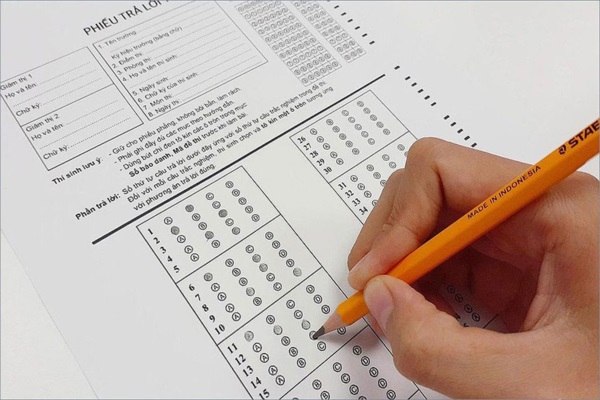
Multiple-choice questions
Tips for Creating Effective Multiple-Choice Tests
Define the Purpose
In the process of creating multiple-choice tests, defining the purpose is the first important step that helps shape the content and structure of the test. The purpose helps clearly identify the educational objectives to be achieved through the test, thereby guiding the selection of appropriate content and question types.
After that, the test creator needs to determine the specific content to be assessed in the test. This ensures that the test will focus on the important knowledge or skills that the test creator wants to evaluate.
Choose the Test Format
With the test formats mentioned above, you can choose one of them or combine one or two of the formats together. The choice of test format will depend on the purpose as well as the knowledge you want to assess.
For example, true/false questions are very suitable for thoroughly testing basic knowledge and assessing the candidate's level of understanding. Each type of multiple-choice question has its own advantages and disadvantages, so the test creator needs to clearly understand the pros and cons of each type to set up the most appropriate test.

Choose the test format before creating the test
Set Up a Test Matrix
To set up a test matrix, you need to do the following:
Step 1. Identify the assessment objectives and content: First, you need to determine the specific assessment objectives and the knowledge content you want to evaluate.
Step 2. Divide the test into sections: Break the test down into smaller sections, reflecting different topics or aspects of the content.
Step 3. Determine the number of questions in each section: Decide how many questions you want to include in each section of the test.
Step 4. Choose the question types: Decide which types of questions you want to use, including multiple-choice questions, fill-in-the-blank questions, matching questions, and other types that suit the assessment objectives. You can choose one of them or combine all of them together.
Step 5. Create the test matrix: Create the test matrix by identifying specific questions and placing them in the corresponding cells of the matrix, ensuring that each section has enough questions and that the types of questions are distributed fairly. Refer to the image of the test matrix below for a clearer understanding.
Step 6. Review: Ensure that each section of the test reflects a part of the knowledge content and has the same level of difficulty.
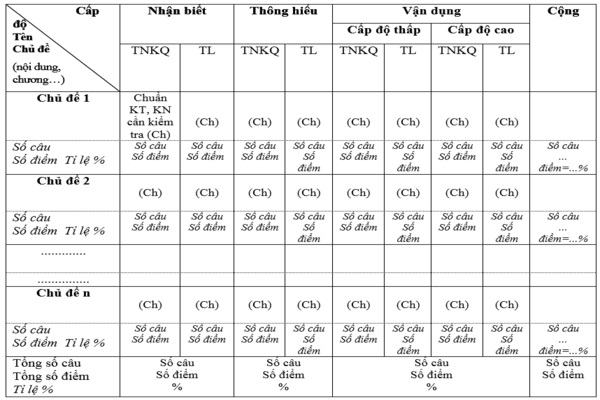
Multiple-choice test matrix
Notes When Creating Multiple-Choice Tests
An important point in creating multiple-choice tests is that you must pay attention to the following issues:
- Clearly define the assessment objectives to select questions that match the desired content to be tested.
- Ensure the test reflects a variety of difficulty levels, from easy to hard, to suit the students' abilities.
- Determine the time for the test and adjust the number of questions to fit the testing time.
- Ensure fairness in question selection, avoiding questions that are too easy or too difficult compared to the assessment objectives.
- Make sure the test is easy to read, easy to understand, and easy to complete.
- Carefully check to ensure there are no spelling mistakes, errors, or inappropriate questions before giving the test to students.
The above is a guide to creating multiple-choice tests that you can refer to and apply to your own test creation, suitable for students' levels and meeting the required knowledge assessment.
Related articles
Applying Bloom’s Taxonomy to Creating Effective Multiple-Choice Exams
5 Tips for Creating Clear and Effective Online Multiple-Choice Questions