In Vietnam, although educational institutions and the Government have focused on implementing digital transformation plans, there are still many shortcomings and challenges. According to Vietnam’s Minister of Education and Training, Nguyen Kim Son, “In the new normal period, many schools are at risk of reverting to traditional teaching methods as before. This is an inevitable consequence when efforts during the pandemic were merely a shift from face-to-face to online communication, lacking the necessary conditions in terms of infrastructure and a shift in pedagogical and management mindsets.”
What is digital transformation in the education sector?
Digital transformation in education is the comprehensive application of technological solutions in management and innovation of teaching methods to enhance the learner’s experience, while also helping educational organizations operate more efficiently and streamlined.
Overall, digital transformation in the education sector focuses on three main areas:
- Innovating teaching methods: e-learning, virtual reality training, smart classrooms, etc.
- Educational management: operational and administrative tools (management of records, assets, information lookup, etc.)
- Technology in the classroom: improving teaching tools and facilities.
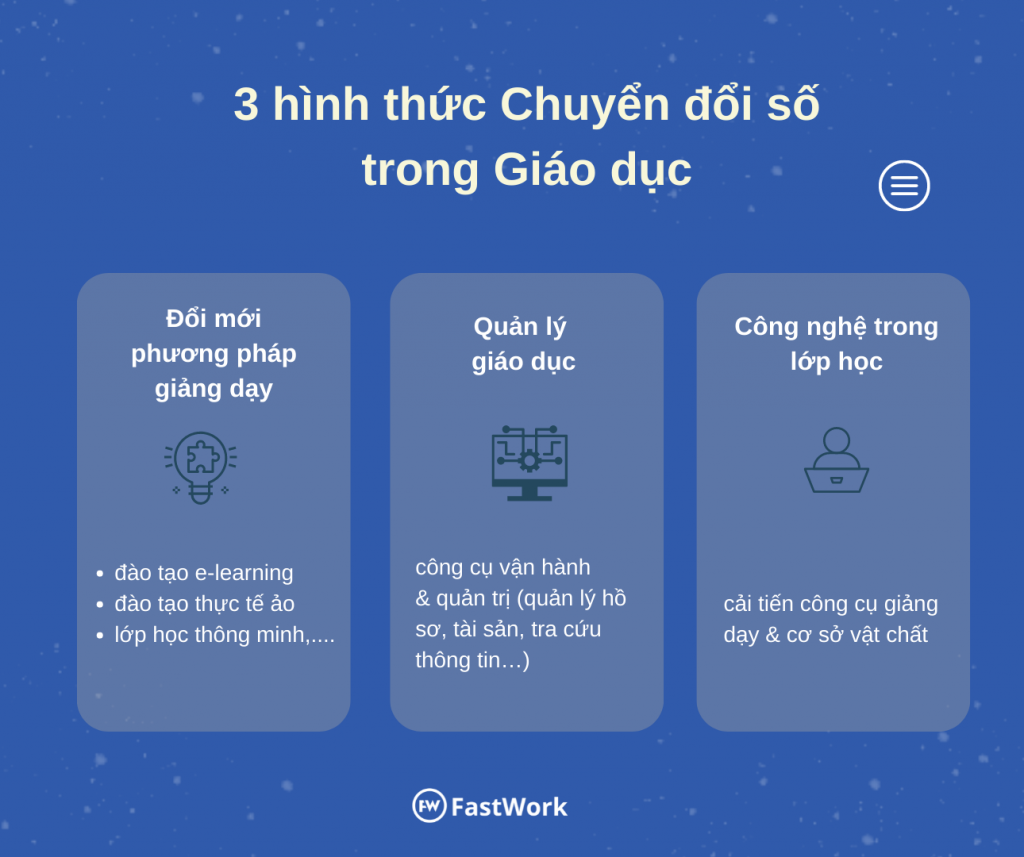
Thus, digital transformation in education is not just about changing teaching and learning methods. Its scope is extremely broad, as technology needs to be integrated and connected holistically throughout the entire management and operational process of the organization. If implemented well, this will be a transformative step that changes educational management thinking, making teaching more convenient and learning of higher quality.
Benefits of digital transformation for the education sector

For the education sector, digital transformation brings many practical benefits to training units, teachers, and learners both in the short and long term, specifically:
1. Increased access to knowledge
The development of online training systems (e-Learning) and digital content tools has made it easier for learners to access courses and sources of knowledge. Thanks to these innovative methods, the learning process has remained smooth and uninterrupted even during social distancing in the Covid-19 pandemic.
Instead of going to school, students and teachers today can proactively choose to study online without being limited by time or location. No matter where you are—remote areas or abroad—you can participate in courses you are interested in, as long as you have a stable Internet connection. In addition, technology software such as text-to-speech also helps remove barriers to accessing learning materials for students with disabilities.
2. Increased interaction, improved training quality
By innovating and applying modern teaching methods, smart classroom models have been introduced to increase the connection and interaction between teachers and students.
Lectures and laboratory sessions have also become less monotonous as schools use teaching support software such as virtual laboratory systems, virtual reality technology (VR), etc. This creates excitement, increases knowledge retention, and enhances experimental skills for learners.
3. Improved management efficiency
The application of management software solutions has helped many training units improve operational efficiency and optimize, streamline their operations.
For example, centers and schools can apply technology to easily and accurately manage the number of equipment and facilities, manage notifications, incoming/outgoing documents, or attendance, shift scheduling, and management of staff, teachers, and students’ records, etc. As a result, the performance and quality of work in administrative and training departments are improved.
4. Optimizing operational costs
One of the undeniable benefits of digitalization, in any industry, is the reduction of administrative workload and significant operational cost savings while still maintaining basic performance.
Digitizing processes allows teachers, departments, students, and parents to exchange information, manage, and collaborate easily and quickly. Working in a digital environment saves time, eliminates unnecessary tasks, and reduces personnel, thereby enabling training units to optimize operational costs.